Showing posts with label Black History. Show all posts

Friday, June 13, 2008

Mixed Bloods and Half Breeds

How “Indian” were Southeastern Indiana’s Indians? Or, on the other side, how often did settler inter-marry with the native inhabitants?

It’s a story that’s difficult to document. But the indications are that the native Americans encountered by settlers were a mixture of tribes, escaped slaves along with a mixture of European blood from white captives and willing marriages.

Some captives, like Heathcoat Pickett and George Ash, lived among the Indians for years. Little has been written about Pickett, before he settled in what became Switzerland County as early as 1790s.

Whether he intermarried with his captors or not, Pickett lived long enough with the tribes to have his ears multilated for adornment . The same is true of the better-known Ash who had the septum of his nose perforated while his left ear was also perforated for the placement of jewlry. Ash also had an Indian wife known as she bear. What is not known is whether the couple had children before Ash returned to white settlements and remarried.

A strong hint of interbreeding was given by James Jackson, who settled in the Kent area Jefferson County, in 1814. In an account published in the Madison Courier in 1874, Jackson gave a description of White Eyes, the best-known area Indian, along with Johnnie Wea, who was traveling with him.

“Old Wea was a black, nasty, mottled color, not a white man, nor a nigger. Old White Eyes was a yeller Indian and so was his son.”

While Jackson didn’t link Johnnie Wea to the Wea tribe, the Weas were Miami Indians who were living apart from the main tribe, while the description of Wea suggests a mixture of Indian, white and black ancestry. The description of White Eyes also doesn’t state explicitly that the man was a mixed breed. But the phrase “Yeller Indian” uses a term that commonly described those who had Indian and black ancestry.

Another account printed in the Courier was from Hiram Prather, who lived in Jennings County. Prather described White Eyes and Big John as Captins under Bill Killbuck. According to this account Bill Kilbuck “was half white, could read and write, and was the son of old Kilbuck, who was killed by Captain Collins near the Pigeon Roost Settlement the evening before the massacre.”

There was a lot of opportunity for commingling.

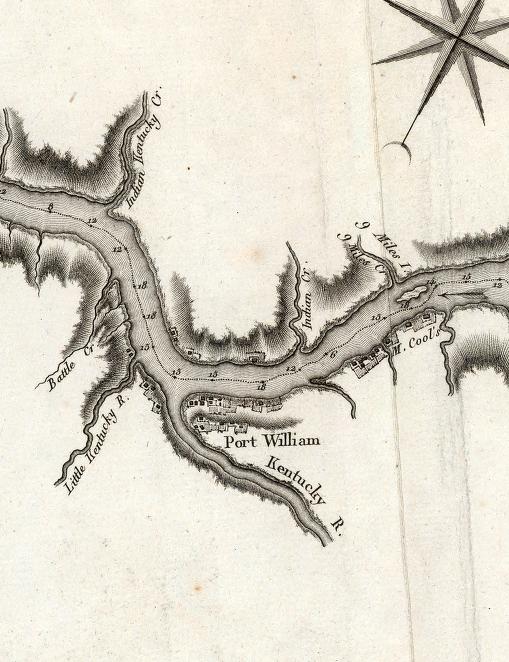
Two Indians with European names, Wilson and John Guinn, were reported to be living in the house of Gershom Lee in 1812. (Lee lived just downstream from Manville in 1816 and was probably there in 1812) Sometime before the Pigeon Roost Massacre, the two were hunting at the headwaters of Indian-Kentuck Creek when they were shot and killed. Two settlers, William Hall and a Lockridge, heard the gunfire and found them dead on the ground. (These is the account that probably gave rise to the story of the killing of White Eyes. Evidence suggests that White Eyes was not murdered.) This account was given in a letter dated Sept. 9, 1812, which was written by adjutant general Percival Butler.

It is known how long the Indians lived in Lee’s house or why they were there, although stories about White Eyes suggest the natives frequently visited settlers homes for meals.

Some mixing took place before settlers arrived in Indiana. These reports are especially prevalent regarding families who lived in the area of Tennessee inhabited by Cherokees. The Storms family, which moved to Shelby Township, reportedly had Cherokee blood.

There were white-Indian marriages in the Jefferson County. But most are known only through family oral traditions that weren’t put down in writing until well after the event.

George Miller, who wrote a column for the Madison Courier for decades in the late 1900s, often described how his ancestor Jacob Miller was buried next to the wall of the Manville cemetery because Jacob had married an Indian. Not far upstream in Madison Township, Samuel Brown, who was born about 1799 in Pennsylvania, is supposed to have married a woman named Half Moon, although the presume wife shown in the household in the 1850 census was Matilda, aged 45.

The censuses aren’t any help. The 1840 census asks only for a number of free blacks in Hoosier households while the 1850 and 1860 censuses asked only if residents were white, black or mulatto. And it’s easy to think those who were Indian, didn’t spread that information easily or often.

Sunday, March 2, 2008

George DeBaptiste: Entrepreneur, Freedom Fighter

In another day, George DeBaptiste would have become wealthy. But his drive, talent and daring, were instead used to fight slavery and his entrepreneurial skills were thwarted by barriers free blacks faced before the Civil War.

Despite this, he succeeded in many ways. He personally se
rved a president. He was a businessman in Madison. In Michigan, he founded the Color Vigilance Committee and the African-American Mysteries the Order of Men of Oppression, a secret society for fighting slavery. He promoted the Colored National Labor Union, raised money to free white abolitionist, Calvin Fairbank from a Kentucky prison, and became one of Michigan’s first black jurors.

He also plotted with famed abolitionist John Brown, also suggesting blowing up southern planters without white help.


Born to free parents in Fredericksburg, Va., DeBaptiste learned the barber’s trade and married in that state. By 1837, he was in Cincinnati, where he first worked on the Underground Railroad. The next year, he moved Madison, opening a barbershop, engaging in trading with Cincinnati and becoming UGRR station manager.


No wonder on March 21, 1839, the Overseers of the Poor for Madison Township tried expel him from Indiana for not posting the bond required of a free black. But pork packer Thomas Paine posted bond and a court found the attempted expulsion illegal.


DeBaptiste next became a steward to William Henry Harrison (a slaveholder), serving him during the 1840 presidential campaign and was White House steward during Harrison’s one-month presidency. DeBaptiste returned to Madison again opening a barbershop that served whites. He rejoined the UGRR and said in 1870, he directly helped 108 fugitives flee north in his years here.


But he did more than that


In 1879, former Madisonian, Richard C. Meldrum recalled how DeBaptiste and other black leaders founded a bank. Unfortunately, the account spent most of its time mocking them, not on details of a remarkable effort.


His anti-slavery efforts were also remarkable. DeBaptiste would wait half the night on the river bank, walk as much as 20 miles with fugitives, and then work during the day. Even after a $1,000 bounty was placed on him, DeBaptiste met with slaves in Kentucky to plan escapes. He reportedly bet one slave owner, “I'll bet you a new hat I'll steal your nigger inside of a month." A few days later, the Kentuckian honored the bet.


With slave owners making like hard on free blacks, he decided to leave Madison and he sold his lot on North Main Street (modern Jefferson) on May 2, 1846.


He moved to Detroit, already home to other members of the Debaptiste family. He prospered there, purchasing a
barbershop, employing others to run it, while he worked as chief clerk and salesman at a black-owned wholesale clothing store. He bought and sold a bakery and then a steamboat, hiring a white man as captain since he could not legally be licensed to run the boat. He later traded the boat for real estate and went into catering. And he continued as an UGRR station operator. After he helped plan John Brown’s raid at Harpers Ferry, Congress subpoenaed DeBaptiste to testify, but dropped that effort upon learning his race.

In the fall of 1863, he raised a black regiment. Appointed its sutler (a authorized independent merchant), he followed the unit through its campaigns.


The censuses gave a measure of wealth while living in Detroit. In 1860 he owned $20,000 in real estate and $1,000 in personal property, while the 1870 count showed $10,000 in real estate and $4,000 in personal property.


He invested in ice cream parlors and a money-losing restaurant and, then opened another. A year before his death on Feb. 22, 1875, he had opened a country house, but failing health forced him to give up the effort.