When I commented that a newspaper supplement in the Madison Courier about the bicentennial was very accurate and one clunker I have found was a statement that the Mt. Pleasant Baptist Church on Madison's hilltop was the parent to Madison's First Baptist Church.
"That's what the church says," was the response I got from a friend. It was that same week that I realized how often in writing church histories, writers neglect to read the church's own minutes.
For example, in the late 1900s, the claim began being made that the Indian-Kentuck Baptist Church was founded in 1812. The difference isn't terribly important, except that a statement written in the minutes said it was founded in 1814 (the minutes up to 1817 are missing). This was probably the same church history published by the Madison Association in 1860 and written by the church's long-time minister, Robert Stevenson.
Of course, written history can lead people astray. A History of Milton Township that was published around 1910 for the Jefferson County Historical Society and probably written by the group's president, William E. Ryker, said the Manville Christian Church grew out of the Manville Baptist Church.
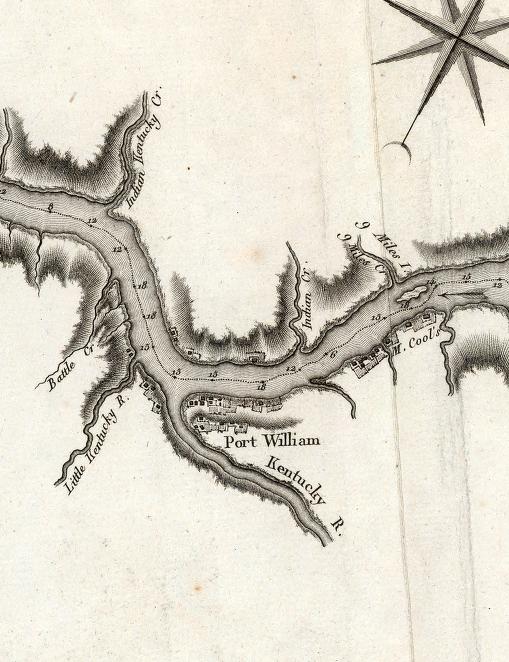
The problem is that there is no record of a Manville Baptist Church. And all evidence points to Manville's growing out of the Milton Baptist Church which sat on the East Prong of the Indian-Kentuck Creek and operated 1829-1836 and 1840 until about 1880.
Annual minutes of meetings of the Coffee Creek Baptist Association, which covered Jefferson County during the second half of the 1820s, show no Manville Baptist Church. What they do show is that John Lanham and William Yates were messengers from Milton Baptist to the Coffee Creek Association meeting of Sept. 5, 1929, just after that church formed.
However, Manville Christian Church records show John Lanham was member No. 2 and William Yates member No. 4. Although this part of the list is undated, it appears members were listed as they joined and that the list dates to Manville's founding in 1830 and these two had jumped ship within a year of Milton's founding.
Back to the Madison Church. While it didn't directly originate in Mt. Pleasant, the real story is more remarkable.
Mount Pleasant voted to disband in April 1831 in order to promote the formation of a Baptist church in Madison and most members joined the newly formed Madison Baptist Church, which is clear from a biographical sketch of Mt. Pleasant's minister, Jesse Vawter.
But Madison had formed a building committee in June 1829 and on December 18 that year, a committee was organized to form a church. The charter members, and these dates, were in a sketch published in the 1869 minutes of the Madison Baptist Association.
And, oh yes, they are in the minutes of the Madison Baptist Church.
Showing posts with label Jefferson County. Show all posts
Showing posts with label Jefferson County. Show all posts
Saturday, July 25, 2009
Monday, May 25, 2009
Jefferson County's Records
This article is designed to provide an overview to the records in the Jefferson County courthouse, and what can be lost if they cannot be salvaged following this month's fire.
After 40 years of studying them, I believe I know more about their contents than anyone as there are many types of records that I have not seen anyone else use, although I do not profess to be an expert on every record.
Nevertheless, wills, probate records, warranty deeds and marriage returns for the 1800s have been microfilmed and copies are available for viewing at several places, including the Madison-Jefferson County library. Modern deeds are being filmed, instead of being placed into books, as a matter of day-to-day operation by the recorder's office. I cannot testify as to whether all wills, probate records and marriages have been filmed from 1900 on.
There are many records that I do not believe have been microfilmed, including the following.
Auditor's Office: County Commissioners Records from 1817 on. The first book has been partly transcribed by Ruth Hoggatt and is available on www.myindianahome.net and there were two books, typed transcriptions of the first two books. These are indexed, but in a way that does not make them easy for family historians to use.
Auditor's Office: Tax Title Sales. These are the deeds that transfer land when an owner loses the property because of failure to pay taxes. If you lost track of your ancestor's land, it's possible it was for nonpayment of taxes and these are not included in the warranty deed books in the recorder's office.
Auditor's Office: Tax assessment records. There were few existing, 1827, 1828 1831 and 1833 for the whole county and 1829 for Madison Township alone. These have been placed on CD and are available through the Jefferson County Historical Society.
Auditor's Office: Land transfer records. Useful, but not critical. Organized by year and township.
Recorder's Office: Warranty deeds, as mentioned these have been microfilmed as have the deed indexes. They exist to the beginning of Jefferson County.
Recorder's Office: Sheriff's Deed Books. There are perhaps five of these and they cover loss of property via sheriff's sale. They are sometimes indexed in the warranty deed index books, but the deeds themselves are not in the regular books. Not microfilmed to my knowledge.
Recorder's Office: Entry books. These show original owners of tracts. The first set was abstracted by W.G. Ruesink and published by the Jefferson County Historical Society.
Recorder's Office: Mortgage records. Before about 1873, these include a lot of deed descriptions that simply reiterate what's in the deed book, but tie the sale to the loan. However, during this period mortgage books also record election of church and fraternal organization officers. They also include some freedom papers for blacks and some incorporation papers. They are hardly used and I don't they are microfilmed.
Recorder's Office: Miscellaneous Record Books. From about 1873 on, these include the church and fraternal organization elections, powers of attorney (often involve sale of a decedent's property and so valuable for family history research), lease and incorporations. Not microfilmed to my knowledge.
Recorder's Office: Apprenticeship book. There is only one of these to my knowledge. These can be very valuable for genealogist. I started transcribing it but didn't get far. It covers about the 1840s and 1850s--I only have referenced one of these in my family. These are not include in the Apprenticeship records abstracted in the 1900s by the John Paul Chapter DAR and have not been filmed
Recorder's Office: Articles of Incorporation. Record of incorporated companies from the second half of the 1800s. One book, not filmed.
Recorder's Office: Soldier's Discharge Record-Civil War soldiers. Ruth Hoggatt abstracted some of these, but not filmed to my knowledge.
Recorder's Office: Will Books. For whatever reason, perhaps four or five of these exist and are duplicates of what's in the circuit court clerk's office.
Recorder's Office:Gas and Oil leases. Not filmed
Circuit Court Clerk's office. Will, marriage return and marriage application books were in the office on the second floor. Other records were placed in the basement
Naomi Sexton published Book A of the wills in the Hoosier Journal of Ancestry. The DAR abstracted wills and two books were placed in the Madison library. I merged these two together and added probate records and estate settlements from deeds and suits. This is available at www.myindianahome.net.
Circuit Court Clerk's office. Guardianship Book. There was only one of these and I have not seen it in a long time. There was a report, I can't remember from who, that it was taken to Indianapolis, either the state library or archives. I know from records I used it included guardianships in the 1860s and 1870s.
Basement: Probate Order Books. Many of these were filmed. Wills from the 1830s and 1840s were filed in these not in books marked Will Books. This led many to believe wills from this period had not survived.
Basement: Complete Probate Order Books. A wealth of material if your ancestor's estate was recorded in these. Both these and the order books can include names of heirs. Not sure if the complete records were microfilmed.
Basement: Civil Order Books. The first Book, Volume A, is critical because at that time, the court not only handled probate and criminal and civil suits, but administered the county business. I am not sure it has been filmed. I believe Naomi Sexton transcribed at least part of this book and published it in the Hoosier Journal of Ancestry.
Basement: Complete Record Civil Order Book. Not filmed to my knowledge
Basement: Criminal Order Books. I forget how the spines are marked, but the criminal cases from the 1800s were in the basement and I don't think they were filmed.
Basement: Indexes to civil and probate books, after 1860. Early books each contained indexes, although since these were not bound to the main volume, some have disappeared.
Other abstracted records
Apprencticeship records. Abstracted by the John Paul DAR in the 1900s, they were transcribed by me and are available www.myindianahome.net. These appear to come from court books and do not include the volume in the recorder's office.
Naturalization records. Abstracted by the John Paul DAR in the 1900s, they were transcribed by me and are available www.myindianahome.net. These appear to come from court books
Sunday, January 11, 2009
A History of Jefferson County's Townships.
For most of its history, ten townships comprised Jefferson County. But during the first two decades of its existence, the county looked much different, not only because it covered more territory, but because townships were created and destroyed.
The original Madison Township was part of Clark County, from which Jefferson was created and when the Jefferson County Common Pleas Court, which handled virtually all county governmental functions, began its work on Feb. 11, 1811, it kept the name of Madison for one of the three townships it created.
The other two were Washington Township and Jefferson Township. Jefferson, with some alterations in its boundaries, became part of Switzerland County when that entity was created in 1814. It initially extended west to the Indian (Greenville) Treat line that runs diagonally to the Northeast from roughly Lamb on the Ohio River.
Washington Township was more extensive. Court records describe it as including all of the residents of the township below the west line of Madison Township., which was a line from the River starting at on the west line of Section 6 Twp. 3N Range 10E. That included all of modern Graham, Hanover, Lancaster, Saluda, Smyrna, and Republican Townships. It also included the western tiers of sections in what is now Monroe Township. (The sections bordering Lancaster); modern Smyrna Township, and the three sections of Madison Township that border the northern boundary of Hanover Township. (a panhandle.)
Sandwiched between Washington and Jefferson Township, Madison Township extended east to the treaty line. Since it extended north to the Grouseland purchase boundary, it also encompassed most of Ripley and Jennings counties. Within modern Jefferson County, it was comprised by modern Shelby and Milton Townships, and most of Madison and Monroe Townships, and initially the part of modern Switzerland County between the Treaty line and the modern county border.
The creation of Jennings County in 1816, probably triggered the actions that the Jefferson County Court took next. It created Graham Township on Feb. 10, 1817, which encompassed the west part of the modern county, except for areas that became Lexington and Saluda Townships on February 13; Lancaster Township, laid off on March 5, also included modern Monroe Township.
On March 12, the court created Pittsburgh Township, which took in a roughly triangular piece of modern Milton Township that was bordered on the southwest by the Indian-Kentuck, starting about the site of Manville. The southern part of Milton Township remained in Madison Township. Republican Township was created the same day. Washington Township disappeared as a result of these actions.
Milton Township , taken from Madison and Pittsburgh Townships on May 12, 1818, included modern Shelby Township running from an east-west line between sections 33 and 33 Twp. 4N Range 11E to the Switzerland County border, leaving a remnant of Pittsburgh
Another vanished township, Edinburgh, is a mystery. There is no reference to its creation or dissolution in county records. The first reference to Edinburgh came on May 6, 1817 when David Talbott was paid for services as an election inspector; Robert Mitchell as an election judge for both Edinburgh and Pittsburgh Townships, Peter Ryker as an election clerk, Samuel Caplinger as judge, John Littlejohn, James Wooley and James Christie as clerks. These men all lived in the Canaan and Barbersville areas. It may have taken in northern Shelby Township, along with Ripley County. It's possible it was destroyed with the creation of Ripley County in 1819, but Jefferson County records simply stopped mentioning it.
The only other boundary chanrges included one that took Paris from Graham Township and made it part of Jennings County, legendarily because it was trouble and was closer to the sheriff at Vernon than at Madison. And the border between Graham Township and Scott County was pushed slightly east. Both measures were approved by the Indiana General Assembly in January 18330.
The original Madison Township was part of Clark County, from which Jefferson was created and when the Jefferson County Common Pleas Court, which handled virtually all county governmental functions, began its work on Feb. 11, 1811, it kept the name of Madison for one of the three townships it created.
The other two were Washington Township and Jefferson Township. Jefferson, with some alterations in its boundaries, became part of Switzerland County when that entity was created in 1814. It initially extended west to the Indian (Greenville) Treat line that runs diagonally to the Northeast from roughly Lamb on the Ohio River.
Washington Township was more extensive. Court records describe it as including all of the residents of the township below the west line of Madison Township., which was a line from the River starting at on the west line of Section 6 Twp. 3N Range 10E. That included all of modern Graham, Hanover, Lancaster, Saluda, Smyrna, and Republican Townships. It also included the western tiers of sections in what is now Monroe Township. (The sections bordering Lancaster); modern Smyrna Township, and the three sections of Madison Township that border the northern boundary of Hanover Township. (a panhandle.)
Sandwiched between Washington and Jefferson Township, Madison Township extended east to the treaty line. Since it extended north to the Grouseland purchase boundary, it also encompassed most of Ripley and Jennings counties. Within modern Jefferson County, it was comprised by modern Shelby and Milton Townships, and most of Madison and Monroe Townships, and initially the part of modern Switzerland County between the Treaty line and the modern county border.
The creation of Jennings County in 1816, probably triggered the actions that the Jefferson County Court took next. It created Graham Township on Feb. 10, 1817, which encompassed the west part of the modern county, except for areas that became Lexington and Saluda Townships on February 13; Lancaster Township, laid off on March 5, also included modern Monroe Township.
On March 12, the court created Pittsburgh Township, which took in a roughly triangular piece of modern Milton Township that was bordered on the southwest by the Indian-Kentuck, starting about the site of Manville. The southern part of Milton Township remained in Madison Township. Republican Township was created the same day. Washington Township disappeared as a result of these actions.
Another vanished township, Edinburgh, is a mystery. There is no reference to its creation or dissolution in county records. The first reference to Edinburgh came on May 6, 1817 when David Talbott was paid for services as an election inspector; Robert Mitchell as an election judge for both Edinburgh and Pittsburgh Townships, Peter Ryker as an election clerk, Samuel Caplinger as judge, John Littlejohn, James Wooley and James Christie as clerks. These men all lived in the Canaan and Barbersville areas. It may have taken in northern Shelby Township, along with Ripley County. It's possible it was destroyed with the creation of Ripley County in 1819, but Jefferson County records simply stopped mentioning it.
The only other boundary chanrges included one that took Paris from Graham Township and made it part of Jennings County, legendarily because it was trouble and was closer to the sheriff at Vernon than at Madison. And the border between Graham Township and Scott County was pushed slightly east. Both measures were approved by the Indiana General Assembly in January 18330.
Thursday, December 25, 2008
Jefferson County’s Mormon Pioneers
No congregation of the Church of Jesus Christ of the Latter Day Saints was successfully established in Jefferson County until the 1960s. But it wasn’t for lack of trying.
It might be better to say no long-lasting congregation was established because there were efforts from very early in the history of the Mormon Church and these continued throughout the 1800s.The earliest record the church reports is the trip by two ministers, Reynolds Cahoon and Samuel Smith, brother of Joseph Smith, who set out for Missouri in June 1831. Along the way, they stopped in Kentucky and preached in Madison, Vienna and Unionville, although no details were given about these appearances.
Next, in the winter of 1832/33, Simeon Carter organized an L.D.S. branch in Hanover, which had 27 members, according to the April 1833 edition of the Evening and Morning Star, a Mormon publication. But no further record of that effort has been found. After that, there is a gap of 20 years of reported church activity in Jefferson County. At a conference in Nauvoo, Ill., held on April 6, 1843, Joshua Holman and John Pierce were appointed as missionaries of Madison. Holman died in 1849, having returned to Nauvoo, and Pierce was not listed in the 18500 Jefferson County census.
What happened next is unclear with only hints given about Mormon activity from records of the Reorganized Church of Latter Day Saints. (They did not call themselves Mormon and the denomination changed its name to Community of Christ in 2000.) At some point a Swiss immigrant, Louis Van Buren of Manville had become an L.D.S. member. This is known because by 1861, he had joined the reorganized church whose Saints Herald said Van Buren had visited the denomination’s headquarters in Lamoni, Iowa. It reported that “Elder Louis Van Buren, of Manville, Jefferson county, Ind., tarried in this city several days. He is a believer in the New Organization, and I am informed that he was an elder in the Old Organization. He is on his way to
The presence of Mormons probably drew the Reorganized Church into Jefferson County for organizing efforts that began in the 1870s with much greater success than the Mormons had achieved.
An 1878 letter by the Rev. James Scott, who spearheaded this activity along with his brother the Rev. John Scott, mentioned that, “There are a great many more of the old saints throughout the county,” but gave no other details. Few of these are known, including, the Rev. William Marshall is known, as a Madison newspaper account said he had been a Mormon, and had been excommunicated by the R.L.D.S. because he believe in polygamy. (In the twentieth century, he was a Baptist and preached at the Mt. Pleasant Baptist Church in Shelby Township.)
The Scotts began their evangelizing by Dec. 7, 1872 when James wrote he had procured a house of preaching. This was probably at Wirt where on June 27, 1873, following 20 days of meetings held by the Scotts, four Madisonians joined the Union Branch which met at the Union School House two and a half miles from Wirt. These included “Brother Woodburn and his wife” who were described as members of the old church. On July 2, 1873, the Daily Courier reported Union Branch had 26 members. James Scott’s 1878 account said the branch began with 10 members under elder Samuel Rector and minister (called a priest) William Blair. By March, 10, 1876, Union had 33 members. By 1883, it was reportedly considering purchase of the Christian Church building in Lancaster. Whatever it did, Union Branch moved into its old building by Nov. 9, 1884, when the Saints Herald reported its church building had been dedicated. This was probably the one building reported for the denomination in Jefferson County by the 1890 census.
There were also attempts to found a congregation in Madison. The May 15, 1873 Saints Herald, noted that Elders were wanted at
While no other records of the Smyrna congregation have been found, more is known about the Mt. Pleasant Branch, which met on the Milton Township of Hall’s Ridge. It was organized on Oct. 13, 1879 with 22 members and conferences of the Reorganized church’s Southern Indiana District were held on Nov. 20, 1879 and March 5, 1881. Since the R.L.D.S. had only one structure in the county in 1890, Mt. Pleasant probably did not have its own building until after the congregation purchased land in 1894. But the church did not last long and in 1904, the property was soon and the new own demolished the building.
By 1900, the L.D.S. itself was ready for one for effort in Jefferson County. Madison’s 1900 census showed Hugh Harvey, Jessie Pay, Isaac Zundel, and Erick Larsen boarding at 204 East Street. All four, born in
Thursday, June 19, 2008
A Phone Company on Every Corner
But anyone who found the state of telephony competition confusing in the after 1984, would have been baffled by the state of the art in the late 1800s and early 1900s.
It was simpler at the beginning when the first telephone was reportedly installed between the starch works and the railroad depot in 1879. It’ likely that private systems were the only ones operating until a public exchange was opened in
In February 1882, the Courier reported work had begun to link
By the time the 1887/88
But things got interesting. The Daily Courier of Nov. 27, 1894 reported local businessmen formed the Madison Telephone Co. because of Central’s rates and at this point, the Central company had 150 subscribers while
While the
Meanwhile, service moved into the country with a company owned by the Green Brothers installing the first telephone in
In the fall of 1903, the
The number of independent companies quickly reached the hundreds for
At one point, there were two systems operating in
This wasn’t area with double service. The
State reports in 1914 showed seven systems operating in
Other lines edged into the county. The
But by this time, small companies were disappearing. The June 28, 1919 Courier reported the Ryker’s Ridge exchange had just closed. The
Friday, June 13, 2008
Mixed Bloods and Half Breeds
It’s a story that’s difficult to document. But the indications are that the native Americans encountered by settlers were a mixture of tribes, escaped slaves along with a mixture of European blood from white captives and willing marriages.
Some captives, like Heathcoat Pickett and George Ash, lived among the Indians for years. Little has been written about Pickett, before he settled in what became
Whether he intermarried with his captors or not, Pickett lived long enough with the tribes to have his ears multilated for adornment . The same is true of the better-known Ash who had the septum of his nose perforated while his left ear was also perforated for the placement of jewlry. Ash also had an Indian wife known as she bear. What is not known is whether the couple had children before Ash returned to white settlements and remarried.
A strong hint of interbreeding was given by James Jackson, who settled in the Kent area
“Old Wea was a black, nasty, mottled color, not a white man, nor a nigger. Old White Eyes was a yeller Indian and so was his son.”
While
Another account printed in the Courier was from Hiram Prather, who lived in
There was a lot of opportunity for commingling.
Two Indians with European names, Wilson and John Guinn, were reported to be living in the house of Gershom Lee in 1812. (Lee lived just downstream from Manville in 1816 and was probably there in 1812) Sometime before the Pigeon Roost Massacre, the two were hunting at the headwaters of Indian-Kentuck Creek when they were shot and killed. Two settlers, William Hall and a Lockridge, heard the gunfire and found them dead on the ground. (These is the account that probably gave rise to the story of the killing of White Eyes. Evidence suggests that White Eyes was not murdered.) This account was given in a letter dated Sept. 9, 1812, which was written by adjutant general Percival Butler.
It is known how long the Indians lived in Lee’s house or why they were there, although stories about White Eyes suggest the natives frequently visited settlers homes for meals.
Some mixing took place before settlers arrived in
There were white-Indian marriages in the
George Miller, who wrote a column for the Madison Courier for decades in the late 1900s, often described how his ancestor Jacob Miller was buried next to the wall of the Manville cemetery because Jacob had married an Indian. Not far upstream in Madison Township, Samuel Brown, who was born about 1799 in Pennsylvania, is supposed to have married a woman named Half Moon, although the presume wife shown in the household in the 1850 census was Matilda, aged 45.
The censuses aren’t any help. The 1840 census asks only for a number of free blacks in Hoosier households while the 1850 and 1860 censuses asked only if residents were white, black or mulatto. And it’s easy to think those who were Indian, didn’t spread that information easily or often.
Subscribe to:
Posts (Atom)