Saturday, June 9, 2012
Paris and Dupont Railroad 1849
Saturday, August 6, 2011
Jefferson County's Battles
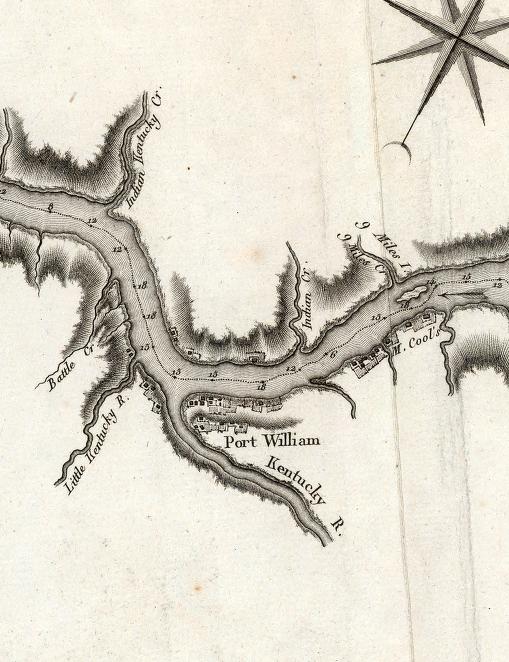
 There's no indication his troops fought anyone in southeastern Indiana as did they in the north. What we do know is the name Battle Creek is on a 1793 map that covers the area. What is not certain is why the creek bears that name but it is clearly labeled on Barker's 1793 map, along with the equally clearly labeled Indian-Kentuck.
Unfortunately, nothing in Wilson's account suggests whether troops had gone upriver, deeper into Switzerland County, or down river into Jefferson, before the fighting broke out.
Thursday, May 13, 2010
Disciples Vs. Baptists in Jefferson County
The friction was shown in the attitudes of the Coffee Creek Baptist church in Jennings County, not far from the Jefferson County border. On the First day of Saturday December 1835, the church minutes show: “On motion is it decided by this church that John B. New and all that hold with him shall not be permitted to preach in our meetinghouse.” And the next action it took was to approve purchase of a lock for the meetinghouse.
New had been a Baptist minister. But he was one of the many who turned to the Christians, who were variously known as Campbellites, after their founder Alexander Campbell, Christian Baptist and Reformers, related to the Reformed Church, which is how the denomination thought of itself as reforming a religion that had strayed from the rules of the Bible.
New arrived in Madison in 1815 and over the next two to three years, he was clerk for the Mt. Pleasant Baptist Church on the Madison Hilltop, the first church (counting it as a successor of the Crooked Creek Baptist Church), founded in Jefferson County.
After attending some of the meetings in Kentucky, he returned to Mt. Pleasant filled with the message and decided to become a minister in 1818. That same year he married and was also on a committee to rewrite Mt. Pleasant’s rules. In the words of an author committed to the truth of the Christian message, New convinced the committee that the only rules it needed were those of the New Testament. The biographical sketch in the book Biographical Sketches of the Pioneer Preaches of Indiana also makes it clear that the Christians saw themselves as in revolt against the Calvinist doctrine of predestination.
The lock at Coffee Creek was just one evidence of conflict. Among the members of the Church of Christ, organized by New and Carey Smith in Madison in 1832, was another elder, Jesse Mavity, who had taught school in the basement of the Masonic Hall along with his brother Henry. “Prior to the organization of the church, who had preached with great acceptance for the several denominations of the city, all of whom were liberal patrons of his school,” But because of Mavity affiliated with the Christians, when he changed his school to a high school, the subscribers withdrew. This account makes it sounds as if the Mavitys were set up for failure by those who urged the change in schools; another that the school was simply abandoned by opponents the new denomination.
Churches changed affiliations. The first Baptist Church in Indiana, the Silver Creek Baptist Church in Clark County, joined the Christians. Two New Light Churches (a dissident form of Presbyterianism), a church named Liberty near Kent and another another Liberty Church at Mud Lick (later called Bellview) became Christian bodies in the 1830s.
But one of the bitterest fights took place in Milton Township, where the newly founded Milton Church found itself subject to the divisive forces. It may not have been more bitter than elsewhere; but three accounts show that it must have been a heated discussion.
All of the accounts have some errors and they gloss over some of the pertinent points, partly because two were written from the viewpoint of the Christians and the other because it was a local history, whose main purpose wasn’t defining religious movements.
The Milton Baptist Church was founded in 1829 in Milton Township about two miles east of modern Manville. It was the first church that organized in and met in Milton Township.
It must have been subject to tension from the beginning for a History of Milton Township written sometime before 1908, probably by William Ryker, then president of the Jefferson County Historical Society, refers to the Manville Christian as growing out of a Manville Baptist Church. No such body every existed—it clearly grew out of Milton.
This account says the church had two ministers, Benjamin Levitt and Joseph Hankins, who were divided on practice, one for open communion, one for closed communion. Then Jacob Short, who had been one of the founders of the Indian-Kentuck Baptist Church, included Beverly Vawter to speak. Son of Baptist minister Philemon Vawter and nephew of Baptist minister Jesse Vawter, Beverly had gone over to the reformers and was a major force in Jefferson and Switzerland County. Hankins, who was the minister at Milton Baptist Church in the early 1830s gets no more mention in his role in the events. But Levitt was an important player.
A biographical sketch of Beverly Vawter, in the same volume that profiled New, said that in the summer of 1830 “he was invited to attend the monthly meeting of a Separate Baptist church near the forks of Indian Kentucky. Their preacher and elder was a man by the name of Levitt, who was bitterly opposed to what he was pleased to denominate Campbellism.”
After Vawter preached and four members confessed and were to be baptized, Levitt was requested to attend their immersion and refused with "No, sir, they are your converts—I will have nothing to do with them." At the next church meeting, it was clear Vawter had won. (The formality of the quotes attributed to Levitt sound like they were constructed in later years, fairly typical for writings of the era.)
The story concludes with “This was the origin of the Church of Christ, now* known as Milton
Church, which still yields the peaceable fruits of righteousness under the pastoral care of Charles Lanham.” This time, the error in church names goes the other way. Because Lanham was known to be a minister at Manville Christian Church, and given the location at the forks of the Indian-Kentuck, the new body was clearly Manville.
Important points are lost here. Levitt, a native of Rhode Island, represented a more liberal Baptist view in which the ministers were sometimes affiliated with the Free Will Baptists, sometimes with the Separate Baptists. The Free Wills formed several congregations in Ripley and Switzerland County, but none in Jefferson County (unless the Milton Church was temporarily a free will). The Separate Baptists had only the church at Center Grove in Shelby Township, which became the regular Hicks Baptist Church in 1894, while there were more in Switzerland and Ripley Counties. Both bodies were non-Calvinist and most congregations were decidedly anti-slavery. There may have been a regional split—a more educated Northeasterner against the home grown ministers. It’s likely there was a whole mix of issues.
In any event, important members of the Milton Church show up in records of the Manville church from its founding. John Lanham and William Yates, who were messengers from the Milton Church to the Coffee Creek Baptist Association in 1829, were members No 2. And No. 4 respectively on the Manville membership list and Jacob Short was No. 21. There are no dates on this list before member No. 36, but it’s possible these were all charter members. And they brought their families within them. The final word on the Hankins role was that they stayed with Milton. Joseph Hankins died in 1836 and the church disbanded, but it reformed with his children playing a major role.
The third account, again from the Christian side, was a letter written on April 7, 1834 and printed in the Christian Evangelist. Its language is pious, bordering on haughtiness.
Not naming the church, but noting its location on the Indian-Kentuck Creek, the writer reported, “We esteem the word of God as living and effective and since we got rid of the Babylonians, thirteen of fourteen have been added to our number. Seven of the old folks remain obdurate, two of them were elders and one a Rabbi.”
Tuesday, March 30, 2010
A Mississippi Fight Over Free Jefferson County Blacks
Sunday, February 14, 2010
Six Feet Under: A Brief Review of Cemetery Histories
Friday, November 13, 2009
Jefferson County's Many Presbyterian Churches
Sunday, August 2, 2009
Speaking Southern Hoosier: Names
And while much of the country terminology, some of it leftover from the Hoosier accent before the Kentucky accent crept north, is gone or dying, it's useful for genealogists, historians and the just curious as to how things were or are pronounced differently.
Other pronunciations that lingered in my family involved names. It took years before I found out that the "Old Doc Mathis place" near China had belonged to a Dr. Mathews. It's just that the name was pronounced Mathis into the late 1900s and it's a pronunciation that bedeviled census takers and later family historians who might not have realized that Mathis and Mathews were the originally the same name.
Then there is the name Banta, a name from the Frisian area of Holland and one of the families that was part of what was called the Low Dutch, such as the Rykers and Demarees. In my father's hands, it was "Bahn-tee" with the "a" pronounced like the "o" in the word bond and the second "a" converted to a "y" or "i" sound. And that Banty or Bonty spelling pops up in census records in the 1800s.
Likewise, the Stewart family name was rendered Steward by my parents. It took me years to realize the Steward bridge over the East Prong of the Indian Kentuck (where U.S. 62 crosses the creek) was spelled Stewart. In fact, that "d" ending harkens back to the original family occupation, when they were Sty-wards (pigkeepers) for Scottish royalty. And locally, Buchanan is not Byoo-kanan, but Buh kanan, a pronunciation that caused the name to be spelled Buckhanan or the like in many records.
Demaree got a different treatment. Instead of Dem-a-ree, my father pronounced it Dumb-a-ree. (No offense please) And that was probably a longstanding pronunciation as the 1840 census spells the name as Dumaree. While the Buchanan pronunciation is still common, the Dumb-a-ree is not. Also disappearing is Sibben-tal for Siebenthal, which is closer to the original German, but more often now, the last syllable has "thal" like the sound in think.
Among other names whose spelling reflected spoken spounds included Bondurant, rendered Bundren or Bundrent, Vernon, often written as Varnon (or worse) and Lewellyn, which often turned out as Lewallen. I can't say that I heard my family use these, but clearly they were not rare versions.
Saturday, July 25, 2009
Church Non History
"That's what the church says," was the response I got from a friend. It was that same week that I realized how often in writing church histories, writers neglect to read the church's own minutes.
For example, in the late 1900s, the claim began being made that the Indian-Kentuck Baptist Church was founded in 1812. The difference isn't terribly important, except that a statement written in the minutes said it was founded in 1814 (the minutes up to 1817 are missing). This was probably the same church history published by the Madison Association in 1860 and written by the church's long-time minister, Robert Stevenson.
Of course, written history can lead people astray. A History of Milton Township that was published around 1910 for the Jefferson County Historical Society and probably written by the group's president, William E. Ryker, said the Manville Christian Church grew out of the Manville Baptist Church.
The problem is that there is no record of a Manville Baptist Church. And all evidence points to Manville's growing out of the Milton Baptist Church which sat on the East Prong of the Indian-Kentuck Creek and operated 1829-1836 and 1840 until about 1880.
Annual minutes of meetings of the Coffee Creek Baptist Association, which covered Jefferson County during the second half of the 1820s, show no Manville Baptist Church. What they do show is that John Lanham and William Yates were messengers from Milton Baptist to the Coffee Creek Association meeting of Sept. 5, 1929, just after that church formed.
However, Manville Christian Church records show John Lanham was member No. 2 and William Yates member No. 4. Although this part of the list is undated, it appears members were listed as they joined and that the list dates to Manville's founding in 1830 and these two had jumped ship within a year of Milton's founding.
Back to the Madison Church. While it didn't directly originate in Mt. Pleasant, the real story is more remarkable.
Mount Pleasant voted to disband in April 1831 in order to promote the formation of a Baptist church in Madison and most members joined the newly formed Madison Baptist Church, which is clear from a biographical sketch of Mt. Pleasant's minister, Jesse Vawter.
But Madison had formed a building committee in June 1829 and on December 18 that year, a committee was organized to form a church. The charter members, and these dates, were in a sketch published in the 1869 minutes of the Madison Baptist Association.
And, oh yes, they are in the minutes of the Madison Baptist Church.
Monday, June 15, 2009
Madison and the International Pork Business
From the earliest days, Midwestern farmers had connections overseas because the only viable route for their products was the Ohio River, taking goods to New Orleans and sometimes beyond. In the footnotes of the book issued as the "History of Switzerland County", Perret Dufour reported how James Bolens went to New Orleans about 1822 and couldn't get a price he could accept and so took his pork cargo to Havana. Dufour also noted how Bolens spotted a threatening looking man in New Orleans, who he also spotted in the crowd in Cuba, suggesting there was a good bit of traffic between those cities.
An author named P.L. Simmons spelled out many of the practices of slaughtering and the market for pork products in an article entitled, "The Commercial Products of the Hog," which was published in the Journal of Agriculture in an issue dated July 1855-March 1857. He reported 38,164 barrels of pork were imported at Liverpool during the year ended Oct. 31, 1853, with 10,500 barrels originating in Canada and the United States. He noted that businesses that catered to the New York market did their slaughtering principally from October 1 to December 1 each year to avoid icing of waterways. Madison's season generally fit into this period.
Two court actions show how the shipping business worked. In 1850, there was an shipment that gave rise to a law suit (Josiah Lawrence vs. White and Stevens) in the U.S. Circuit Court regarding "A contract to deliver pork at Madison, in the State of Indiana, well put up, for the English market …" The pork was shipped to New Orleans and then to Baltimore, where it was received spoiled. The contract called for the delivery of 319 boxes of long middles of pork with the Cumberland cut, meaning part of the bone was left in. Each box contained seven or eight middles. The contract had called for 500 boxed, but that was reduced. That meant the original plan involved delivery of middles from more than 3,500 hogs. The defendants (presumably David White and Stephen Stevens) won their case, largely because the defendant found the pork in good order at Madison.
Even after its boom had passed, Madison was still involved in the international trade. Another Madison packer, Fitch & Son, squared off against City of Madison who assessed for pork as personal property in 1860 and 1861. The Indiana Supreme Court ruled against Madison. Noting many residents engaged in businesses shipping goods to New Orleans and to foreign markets it commented that the pork business could not be taxed.
"Filch & Son, during all that time, had no money or other personal property except their pork, all of which was for export, and was then in process of being exported to a foreign market." Those were key words for the court noted the Madison city charter, as amended in 1849, exempted produce held for export or in transit and found that the pork fit that definition.
Monday, May 25, 2009
Jefferson County's Records
After 40 years of studying them, I believe I know more about their contents than anyone as there are many types of records that I have not seen anyone else use, although I do not profess to be an expert on every record.
Nevertheless, wills, probate records, warranty deeds and marriage returns for the 1800s have been microfilmed and copies are available for viewing at several places, including the Madison-Jefferson County library. Modern deeds are being filmed, instead of being placed into books, as a matter of day-to-day operation by the recorder's office. I cannot testify as to whether all wills, probate records and marriages have been filmed from 1900 on.
There are many records that I do not believe have been microfilmed, including the following.
Auditor's Office: County Commissioners Records from 1817 on. The first book has been partly transcribed by Ruth Hoggatt and is available on www.myindianahome.net and there were two books, typed transcriptions of the first two books. These are indexed, but in a way that does not make them easy for family historians to use.
Auditor's Office: Tax Title Sales. These are the deeds that transfer land when an owner loses the property because of failure to pay taxes. If you lost track of your ancestor's land, it's possible it was for nonpayment of taxes and these are not included in the warranty deed books in the recorder's office.
Auditor's Office: Tax assessment records. There were few existing, 1827, 1828 1831 and 1833 for the whole county and 1829 for Madison Township alone. These have been placed on CD and are available through the Jefferson County Historical Society.
Auditor's Office: Land transfer records. Useful, but not critical. Organized by year and township.
Recorder's Office: Warranty deeds, as mentioned these have been microfilmed as have the deed indexes. They exist to the beginning of Jefferson County.
Recorder's Office: Sheriff's Deed Books. There are perhaps five of these and they cover loss of property via sheriff's sale. They are sometimes indexed in the warranty deed index books, but the deeds themselves are not in the regular books. Not microfilmed to my knowledge.
Recorder's Office: Entry books. These show original owners of tracts. The first set was abstracted by W.G. Ruesink and published by the Jefferson County Historical Society.
Recorder's Office: Mortgage records. Before about 1873, these include a lot of deed descriptions that simply reiterate what's in the deed book, but tie the sale to the loan. However, during this period mortgage books also record election of church and fraternal organization officers. They also include some freedom papers for blacks and some incorporation papers. They are hardly used and I don't they are microfilmed.
Recorder's Office: Miscellaneous Record Books. From about 1873 on, these include the church and fraternal organization elections, powers of attorney (often involve sale of a decedent's property and so valuable for family history research), lease and incorporations. Not microfilmed to my knowledge.
Recorder's Office: Apprenticeship book. There is only one of these to my knowledge. These can be very valuable for genealogist. I started transcribing it but didn't get far. It covers about the 1840s and 1850s--I only have referenced one of these in my family. These are not include in the Apprenticeship records abstracted in the 1900s by the John Paul Chapter DAR and have not been filmed
Recorder's Office: Articles of Incorporation. Record of incorporated companies from the second half of the 1800s. One book, not filmed.
Recorder's Office: Soldier's Discharge Record-Civil War soldiers. Ruth Hoggatt abstracted some of these, but not filmed to my knowledge.
Recorder's Office: Will Books. For whatever reason, perhaps four or five of these exist and are duplicates of what's in the circuit court clerk's office.
Recorder's Office:Gas and Oil leases. Not filmed
Circuit Court Clerk's office. Will, marriage return and marriage application books were in the office on the second floor. Other records were placed in the basement
Naomi Sexton published Book A of the wills in the Hoosier Journal of Ancestry. The DAR abstracted wills and two books were placed in the Madison library. I merged these two together and added probate records and estate settlements from deeds and suits. This is available at www.myindianahome.net.
Circuit Court Clerk's office. Guardianship Book. There was only one of these and I have not seen it in a long time. There was a report, I can't remember from who, that it was taken to Indianapolis, either the state library or archives. I know from records I used it included guardianships in the 1860s and 1870s.
Basement: Probate Order Books. Many of these were filmed. Wills from the 1830s and 1840s were filed in these not in books marked Will Books. This led many to believe wills from this period had not survived.
Basement: Complete Probate Order Books. A wealth of material if your ancestor's estate was recorded in these. Both these and the order books can include names of heirs. Not sure if the complete records were microfilmed.
Basement: Civil Order Books. The first Book, Volume A, is critical because at that time, the court not only handled probate and criminal and civil suits, but administered the county business. I am not sure it has been filmed. I believe Naomi Sexton transcribed at least part of this book and published it in the Hoosier Journal of Ancestry.
Basement: Complete Record Civil Order Book. Not filmed to my knowledge
Basement: Criminal Order Books. I forget how the spines are marked, but the criminal cases from the 1800s were in the basement and I don't think they were filmed.
Basement: Indexes to civil and probate books, after 1860. Early books each contained indexes, although since these were not bound to the main volume, some have disappeared.
Other abstracted records
Apprencticeship records. Abstracted by the John Paul DAR in the 1900s, they were transcribed by me and are available www.myindianahome.net. These appear to come from court books and do not include the volume in the recorder's office.
Naturalization records. Abstracted by the John Paul DAR in the 1900s, they were transcribed by me and are available www.myindianahome.net. These appear to come from court books
Sunday, March 22, 2009
Michael Bright Corners Madison's bank stock
The question is not whether Michael G. Bright, brother of powerful Senator Jesse G. Bright conspired to capture a lion’s share of stock at the branches of the Indiana State Bank. The question is whether financier James F.D. Lanier was in on the deal.
Bright did everything he could to control the sale of stock at
Technically, the
Bright acquired 1,200 of the 2,000 shares sold at
If in our modern view this procedure smelled rotten, there were many people who thought so then, which resulted in state senate’s appointing an investigating committee, which took testimony in January and February 1857, to see if there was corruption in the process legislature’s approval of the bill granting the bank charter.
During his testimony, Bright was unapologetic for his actions. “I took myself—sixty thousand dollars. I meant to take stock enough to control the branch at
The committee tried to determine if any legislators had been illegally influenced in their passage of the bill that established the process. David Branham, who represented the area in the general assembly, testified that when he and John R. Cravens (one of Lanier’s sons-in-law), who had voted for the bank bill as a member of the state senate, met with the commissioners who were running the sale, they were informed that the subcommissioners at Madison “must be acceptable to M. G. Bright.” Finally, it was agreed to choose three subcommissioners and then let Bright pick from those. But Bright chose none of those recommended. Branham said Bright offered him the chance to buy stock at the opening, but he did not accept the offer.
Perhaps the most stinging testimony given by Branham came in the following exchange. “Question. Were, or were not the persons appointed sub-commissioners for the
Bright was coy in denying there was undue influence on legislators prior to the passage of the bill as shown in the following testimony.
“Question. What do you know, if anything, about the friends of the bank being engaged in treating the members with oyster suppers, liquors, or otherwise, as a means of enlisting them in favor of the proposed bank charter?
Answer. I saw gentlemen, who, I know, were friendly disposed to the establishment of a bank, frequently eating oysters, and drinking liquors with members of the legislature; nor did I notice anything unusual in their doing so; nor did I regard it as a means of bribing them to vote for the bank.”
But he then said he knew nothing about any influence peddling.
Williamson Dunn, another one of Lanier’s sons-in-law, said he showed up at the office in
The committee clearly was trying to determine the nature of the agreement between Michael Bright and Lanier, who immediately acquired Bright’s
Cravens, who visited the Madison office that day, said he probably would have purchased some stock, but when he demanded to see the books, he was informed they were sealed and on the way to Indianapolis.
“There was dissatisfaction at
No one was able to point a finger directly Lanier and his company, Winslow & Lanier. But there was testimony the firm ended up with most of the stock of the
Saturday, February 28, 2009
First Family Non History
One of the most glaring examples was the DAR's decision to admit Johnston/Johnson Brown of Jefferson and Switzerland County, who, it was claimed died in 1869 at 109 and was supposedly squirrel shooting at age 100. Researchers Al and Margaret Spiry demolished this--suggesting the old man was simply a good story teller. Johnson's father signed to given him permission to marry in 1795 in Nelson County, Ky., meaning he wasn't 21 years old. Do the math.
There are some other great tales. The DAR has Ralph Griffin as having died in July 1838 and buried at Springdale Cemetery. However, the Jefferson County Probate records show he died on Sept. 13, 1838 at the hosue of John Rogers (his grandson-in-law and executor) in Switzerland County. Since Rogers lived near Pleasant, and since Rogers and Ralph's wife Catherine and son David Griffin are buried at Brushy Fork Baptist Church, it's more likely his unmarked grave is there. By the way, the newspaper article about the burial said simply that a Mr. Griffin was buried in July 1838 (and Springdale was established in 1839.)
Then there was George Buchanan, whose family established Buchanan's Station, the blockhouse on the Jefferson County-Ripley County line, in 1813 according to the DAR, in 1812, according to a contemporary account.
George lived 1721-1818 according to the DAR's records; lived to be more than 100, according a newspaper article of the reminiscences of his grandson George W. in 1910, or died in 1815, according to a stone that now stands in the Buchanan family cemetery opposite the replica of the blockhouse. (It was probably moved there about 1985 from the McLaughlin Cemetery)
Many individuals have been admitted to the DAR and SAR based on the Pennsylvania Archives that show George Buchanan served from 1777 through 1781 in the Fourth Pennsylvania Continental line. The problem is, the record does not say which George Buchanan, and there are plenty to choose from in that place and time.
Now, U.S. records show that in 1786 Ezekiel and Elizabeth Buchanan, no relationship given, were paid for services of George Buchanan in the Fourth in Pennsylvania. They were paid with interest accruing from Jan. 1, 1781, which suggests the service ended on that date. The only conceivable reason someone other than the solider would be paid is that the solider, George Buchanan, had died by 1786.
Then there is Gerardus Ryker, who the DAR was Gerardus was an ensign in Col. Theunis Day's Bergen Co. Regiment, New Jersey Militia and was also an ensign in the Battalion of Major Mauritious Goetschius, New Jersey State Troops, serving extending from 1776 to 1781.
Ryker, however, moved to modern West Virginia in 1778, then to Kentucky in 1779 and was killed by Indians in that state in 1781. Based on my suggestion this didn't make since, Lynn Rogers of Dayton, Ohio, pursued this conflict and believes the Gerardus in New Jersey was a relative of the same name.
Our final problem is Samuel Welch. The DAR put a stone at his family plot on Scott's Ridge, Shelby Township, commemorating his Revolutionary service in Springer's Legion. Unfortuantely, Springer's unit served in the Indian Wars after the Revolution was over. In fact, the DAR started rejecting applicants because Samuel's initial pension application was rejected because of this fact. However, when he resubmitted his claim, it was approved. Either Samuel served as a teenager, or he was a complete liar--take your pick
Then, there's the question of his wife's maiden name. The book, "Welch and Allied Families," which was printed in 1932, carried a transcribed letter from Knox Jamison, that had been written in 1924. Jamison wrote that he checked Samuel's Bible (the one I own and that was passed down along with his farm in my family), and gave Samuel's marriage to Jane Cunningham in 1797. The Welch Book author created a nice family tree for Jane that many descendants have elaborated on, listing her parents as a John Cunningam and Ann Sinclair, who lived in Massachusetts.
There are two probems with this. The first is that some Cunningham researchers show this couple's daughter Jane, who married a Samuel Welch, died in Massachusetts. The second problem is that's not what the Bible says, and the author who transcribed Jamison's letter simply got it wrong.
The Bible shows her name as Jane Cumming (it actually looks more like Cunning, but I think that's an issue of handwriting.) There's another family Bible, one that Samuel reportedly carried with him as a soldier, that shows her name as Cummins or Cummings (the last letters are blurry.)
And this are merely lines I have investigated well. Imagine the possibilities!